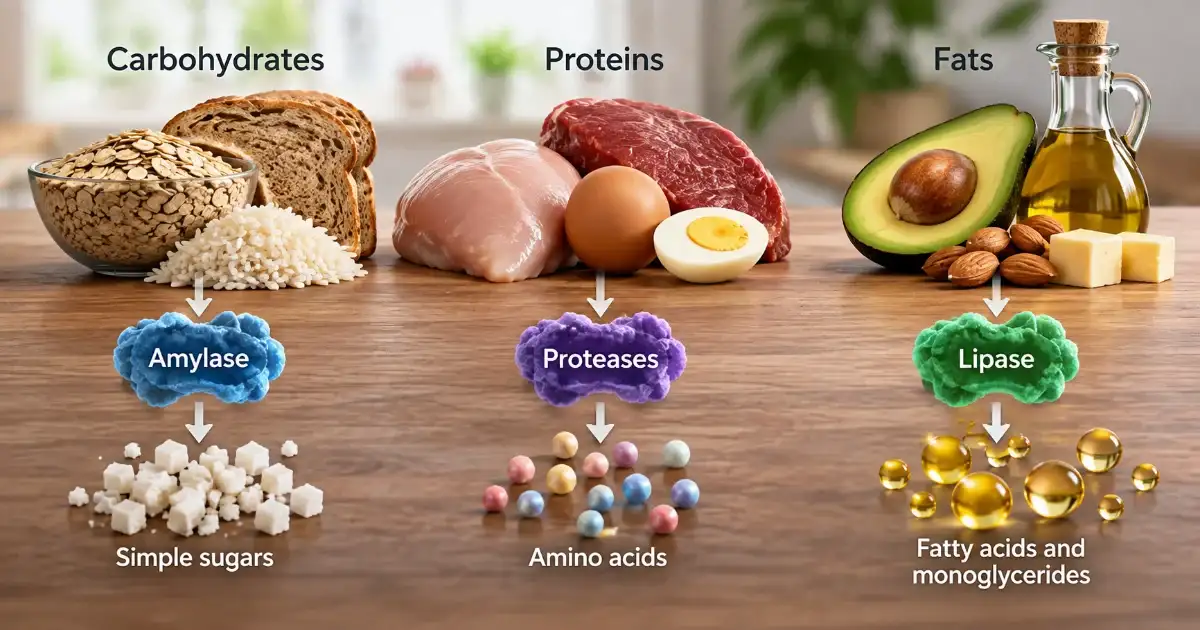
Food contains carbohydrates, proteins, and fats that are often too large for direct absorption. Digestive enzymes help solve this problem by breaking these food components into smaller molecules. These enzymes are proteins that speed up chemical reactions involved in digestion.
Each enzyme works on specific substances. For example, amylase acts on starch, while proteases break down proteins and lipase acts on fats. This specific action helps turn complex food components into smaller units the body can process and absorb.
Understanding digestive enzymes also helps explain how food is chemically broken down during digestion. Their role goes beyond simply making food smaller. They help release nutrients from food so those nutrients can become available to the body.
What Are Digestive Enzymes?
Digestive enzymes are proteins that help break food into smaller molecules. These smaller molecules can then be absorbed and used by the body.
Enzymes act as biological catalysts. This means they speed up chemical reactions without being used up in the process. During digestion, different enzymes act on different food molecules.
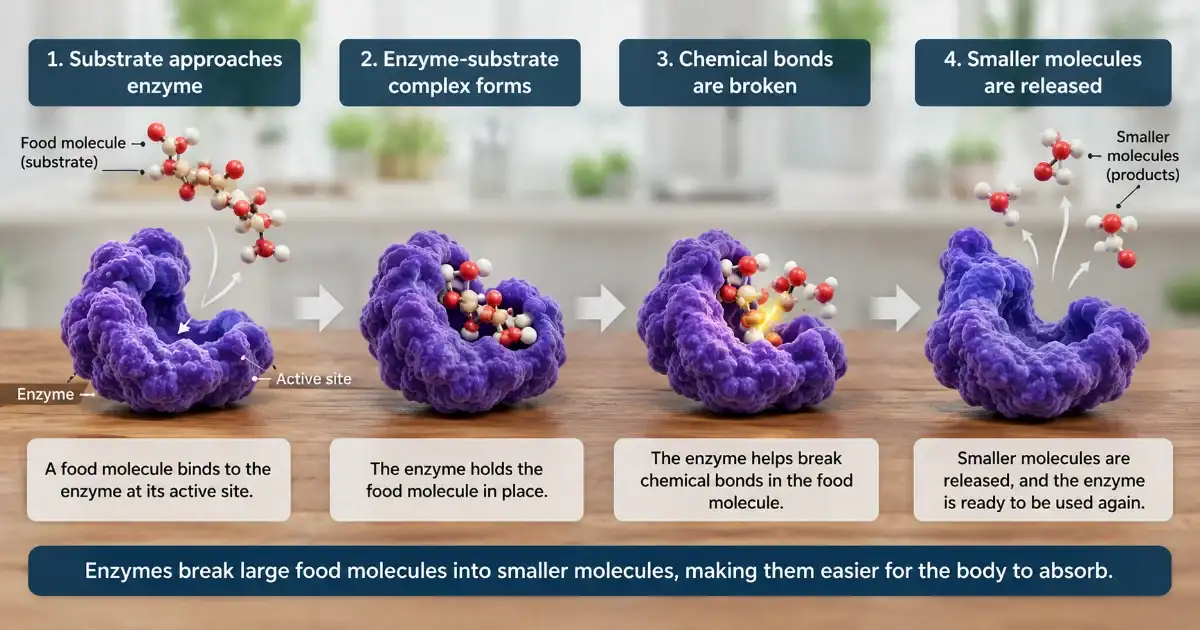
Each enzyme has a specific target called a substrate. The substrate fits into a region of the enzyme called the active site. This interaction allows the enzyme to change the substrate into smaller products.
For example, amylase acts on starch, while lipase acts on fats. Proteases act on proteins and help break them into smaller peptides and amino acids.
This specificity is important because one enzyme cannot perform every digestive task. Different enzymes are needed for different nutrients.
Digestive enzymes also differ from nutrients. Nutrients provide materials the body needs, while enzymes help process food components. They also differ from hormones, which act as chemical messengers.
Therefore, enzymes involved in digestion play an important role in making nutrients available for absorption.
How Do Enzymes Break Down Food?
Digestive enzymes work by speeding up chemical reactions that change large food molecules into smaller ones. They do not simply break food. Instead, they help split specific chemical bonds within food molecules.
The enzyme then helps change the substrate into smaller products. After the reaction, the enzyme remains available to act again.
For example, amylase helps break starch into smaller carbohydrate molecules. Proteases help split proteins into smaller peptides and amino acids. Lipase helps break fats into fatty acids and monoglycerides.
This process turns large food molecules into smaller molecules that the body can absorb:
Large food molecule → enzyme action → smaller molecules → absorption
Different nutrients require different enzymes. This is why the body produces several types of food-digesting enzymes.
Enzyme action also depends on suitable conditions. Factors such as acidity and temperature can affect how well an enzyme works.
As a result, digestive enzymes support the chemical breakdown of food. They help convert complex food components into smaller forms that the body can absorb and use.
Digestive Enzymes That Break Down Carbohydrates, Proteins, and Fats
Different nutrients need different enzymes for chemical breakdown. Carbohydrates, proteins, and fats each have specific digestive enzymes that act on them. These enzymes act on specific food molecules and produce smaller components. The resulting molecules then move toward absorption and use by the body.

Amylase and Carbohydrate Digestion
Amylase is a carbohydrate-digesting enzyme that helps break down starch. Starch is a complex carbohydrate found in foods such as grains, potatoes, and many legumes.
Salivary amylase begins starch digestion in the mouth. It starts breaking starch into smaller carbohydrate molecules, including shorter chains and maltose.
Starch digestion continues after food reaches the small intestine. The pancreas releases pancreatic amylase, which acts on remaining starch.
Pancreatic amylase continues breaking starch into smaller carbohydrate products. Other enzymes then break these products into simple sugars that the body can absorb.
Therefore, amylase plays an important role in the early stages of carbohydrate breakdown. Its action helps convert complex starch into smaller molecules.
Proteases and Protein Digestion
Proteases are a group of protein-digesting enzymes. They break proteins into smaller peptides and, eventually, individual amino acids.
Protein digestion begins with pepsin, an enzyme that works in the acidic environment of the stomach. Pepsin breaks large protein molecules into smaller peptide chains.
Further protein digestion occurs in the small intestine. The pancreas releases several proteases, including trypsin and chymotrypsin.
Trypsin helps break proteins and larger peptides into smaller peptide fragments. Chymotrypsin also acts on protein chains and supports their continued breakdown.
Peptidases then act on smaller peptides. They split these molecules into individual amino acids or very small peptide units.
The body can absorb amino acids through the lining of the small intestine. These amino acids contribute to many normal body functions and help support the body’s protein needs.
Therefore, protein digestion involves several enzymes working at different stages. No single protease handles the entire process from beginning to end.
Lipase and Fat Digestion
Lipase is the main digestive enzyme responsible for breaking down dietary fats. It acts mainly on triglycerides, which are the primary form of fat in many foods.
Pancreatic lipase plays a major role in fat digestion. It breaks triglycerides into smaller molecules, mainly fatty acids and monoglycerides.
However, lipase works more effectively when fat is dispersed into smaller droplets. Bile helps with this process by emulsifying fat in the small intestine.
Bile is not a digestive enzyme. Instead, it helps increase the surface area available for lipase to act.
The resulting fatty acids and monoglycerides can then take part in the absorption process. Thus, lipase plays a key role in making dietary fat available for further use by the body.
Lactase and Lactose Digestion
Lactase is an enzyme that breaks down lactose, the natural sugar found in milk and many dairy foods. It acts on lactose in the small intestine.
Lactase splits lactose into two simpler sugars, glucose and galactose. These smaller sugars can then be absorbed through the intestinal lining.
Lactase activity varies among individuals. When the body produces too little lactase, some lactose may remain undigested and reach the large intestine.
Therefore, lactase has a specific role in lactose digestion. It helps convert a larger milk sugar into smaller sugars that the body can absorb.
Where Do Digestive Enzymes Work?
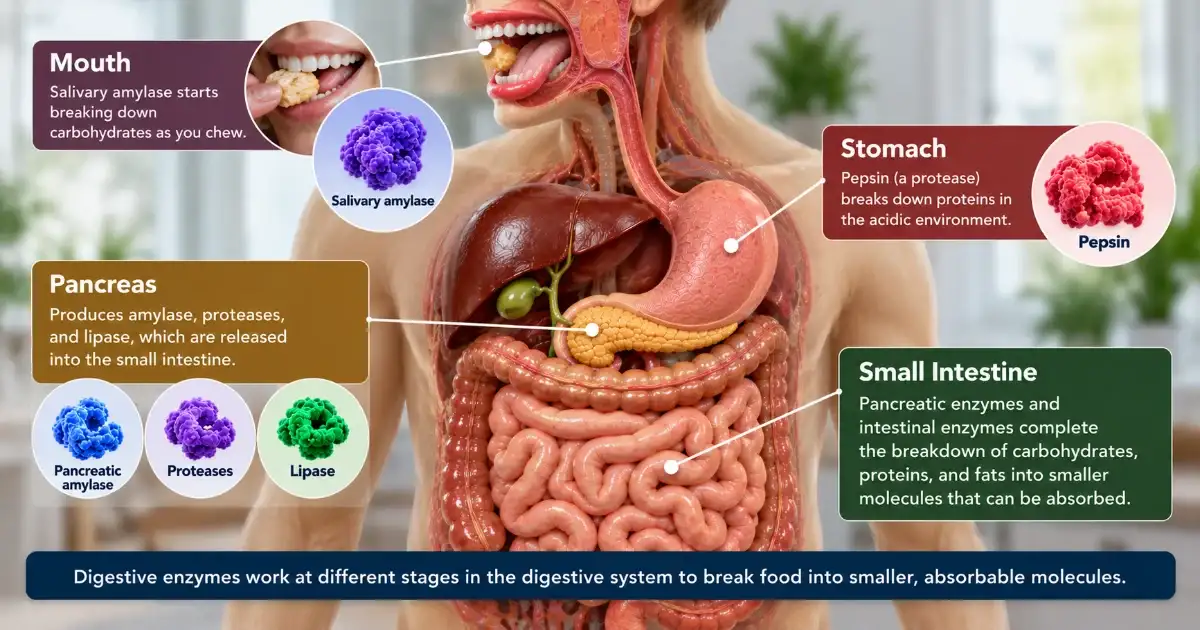
Digestive enzymes work at different locations along the digestive tract. Each location provides conditions that suit specific enzymes and their target food molecules.
In the mouth, salivary amylase begins breaking down starch. It acts while food is chewed and mixed with saliva.
In the stomach, pepsin begins protein digestion. It works in the acidic stomach environment and breaks proteins into smaller peptide chains.
Most enzymatic digestion occurs in the small intestine. Pancreatic amylase, lipase, trypsin, and other proteases act there. They continue breaking down carbohydrates, fats, and proteins.
The pancreas produces several digestive enzymes and releases them into the small intestine. This makes it an important source of enzymes for food digestion.
The lining of the small intestine also produces enzymes such as lactase and peptidases. These enzymes complete the breakdown of certain carbohydrates and peptides.
| Location | Important Enzymes | Main Action |
| Mouth | Salivary amylase | Begins starch digestion |
| Stomach | Pepsin | Begins protein digestion |
| Small intestine | Pancreatic amylase, lipase, proteases | Major enzymatic breakdown |
| Small intestine lining | Lactase and peptidases | Completes specific nutrient digestion |
Digestive enzymes are one part of the larger process through which the body processes food and makes its nutrients available for use.
What Are the Main Digestive Enzymes?
There are many digestive enzymes, and each works on specific food components. Seven important examples are amylase, pepsin, trypsin, chymotrypsin, lipase, lactase, and peptidases.
| Enzyme | Main Food Component | Main Role |
| Amylase | Starch | Breaks starch into smaller carbohydrates |
| Pepsin | Protein | Begins protein digestion |
| Trypsin | Protein | Breaks proteins and peptides into smaller fragments |
| Chymotrypsin | Protein | Helps break down proteins |
| Lipase | Fat | Breaks down triglycerides |
| Lactase | Lactose | Breaks lactose into glucose and galactose |
| Peptidases | Peptides | Completes later stages of protein digestion |
These enzymes represent some of the main types involved in digesting carbohydrates, proteins, and fats.
Why Are Digestive Enzymes Important?
Digestive enzymes are important because they help break large food molecules into smaller ones. These smaller molecules can then take part in nutrient absorption.
Carbohydrates need enzymatic breakdown before many of their components can be absorbed. Amylase starts starch digestion, while other enzymes complete the process.
Proteases break proteins into smaller peptides and amino acids. This step makes the products of protein digestion suitable for absorption.
Lipase breaks dietary triglycerides into fatty acids and monoglycerides. These products can then take part in the absorption of dietary fat.
Digestive enzyme activity also helps coordinate food breakdown at different stages. Each enzyme acts on specific food components under suitable conditions.
Therefore, digestive enzymes support normal digestive processes by making nutrients available in smaller forms. Their action contributes to the efficient processing of carbohydrates, proteins, and fats.
Can Foods Provide Digestive Enzymes?
Some foods naturally contain enzymes, but these enzymes differ from those produced by the human digestive system. They can occur in fresh foods and fermented foods.
Pineapple contains bromelain, a group of enzymes that can break down proteins. Papaya contains papain, another protein breaking enzyme. Bromelain is a group of protein breaking enzymes found in pineapple.
Fermented foods can also contain enzymes produced during fermentation. However, the amount and activity of these enzymes can vary between foods and preparation methods.
The digestive system produces its own enzymes in the mouth, stomach, pancreas, and small intestine. These enzymes carry out the main enzymatic steps of normal food digestion.
Therefore, foods containing natural enzymes should not be viewed as a replacement for the body’s digestive enzymes. A varied diet can provide many nutrients, while the body continues to produce the enzymes needed for digestion.
Digestive Enzyme Supplements: When Are They Used?
Digestive enzyme supplements provide enzymes from outside the body. They differ from the enzymes naturally produced by the digestive system.
Some enzyme preparations have specific uses. For example, lactase products can help break down lactose for people who have difficulty digesting it. Pancreatic enzyme replacement can also provide needed digestive enzymes when the pancreas does not produce enough.
However, these products are not automatically appropriate for everyone. Their usefulness depends on the specific digestive problem and the enzymes involved.
Persistent bloating, abdominal discomfort, diarrhea, or other digestive symptoms should not simply be managed with enzyme supplements. The underlying cause may need proper evaluation.
Therefore, digestive enzyme supplements have a more specific role than general digestive support. They should be considered based on individual needs rather than as a routine part of everyone’s diet.
Frequently Asked Questions About Digestive Enzymes
Digestive enzymes work on different food components and at different stages of digestion. These common questions cover their main roles, sources, and uses.
What are digestive enzymes?
Digestive enzymes are proteins that speed up reactions that break food into smaller molecules. These molecules can then take part in absorption.
How do digestive enzymes break down food?
They act on specific food molecules and help split chemical bonds. This changes large carbohydrates, proteins, and fats into smaller products.
What are the main digestive enzymes?
Important examples include amylase, pepsin, trypsin, chymotrypsin, lipase, lactase, and peptidases. Each enzyme has a specific role in digestion.
Which enzymes break down carbohydrates, proteins, and fats?
Amylase breaks down starch and other carbohydrates. Proteases digest proteins, while lipase breaks down dietary fats into smaller molecules.
Where are digestive enzymes produced?
Digestive enzymes are produced in several locations, including the salivary glands, stomach, pancreas, and small intestine. Each location contributes specific enzymes.
Are digestive enzymes found in food?
Yes. Some foods naturally contain enzymes, such as bromelain in pineapple and papain in papaya. Fermented foods can also contain enzymes.
Who should not take digestive enzyme supplements?
No. The body normally produces the enzymes needed for digestion. Supplements have specific uses and are not automatically suitable for everyone.
Conclusion
Digestive enzymes help convert large food molecules into smaller molecules during digestion. These smaller products can then take part in nutrient absorption.
Different enzymes work on different types of food. Amylase helps break down carbohydrates, especially starch. Proteases break proteins into smaller peptides and amino acids.
Lipase breaks dietary fats into fatty acids and monoglycerides. Other enzymes, such as lactase and peptidases, handle specific parts of digestion.
Together, these enzymes support the normal breakdown of food. Their activity helps make nutrients available in forms the body can absorb and use.
Understanding their roles also shows why different food components require different enzymes during digestion.
Disclaimer:
This article is for informational purposes only. It covers general food and nutrition topics and does not provide medical advice. Nutritional needs vary between individuals, so food choices should be part of a varied and balanced diet. For personal health concerns, consult a qualified healthcare professional.


